Brown Sugar Powder Packaging Machine: Improving Filling Accuracy and Production Efficiency
Brown sugar powder has become increasingly popular in food manufacturing, beverage preparation, bakery products, and retail portion packaging. However, its fine particles, moisture sensitivity, and tendency to form lumps can make automated packaging more challenging than packaging free-flowing granules. A suitable brown sugar powder packaging machine can help manufacturers achieve accurate dosing, stable operation, reliable sealing, and consistent package quality.
For B2B food processors, choosing the right packaging equipment is essential for controlling material waste, reducing labor requirements, and maintaining efficient production. Modern powder packaging systems combine precise filling technology with automated bag forming and sealing to meet different production requirements.
Understanding Brown Sugar Powder Packaging Machines
A brown sugar powder packaging machine is designed to measure and pack powdered sugar products into sachets, pouches, bags, or other flexible packaging formats. The equipment can be configured according to the characteristics of the product, required filling weight, package dimensions, and desired production capacity.
Because brown sugar powder can absorb moisture and become compacted, the feeding system plays an important role in maintaining consistent product flow. Auger filling technology is commonly used for powder applications because controlled screw rotation allows the machine to dispense a predetermined quantity of product.
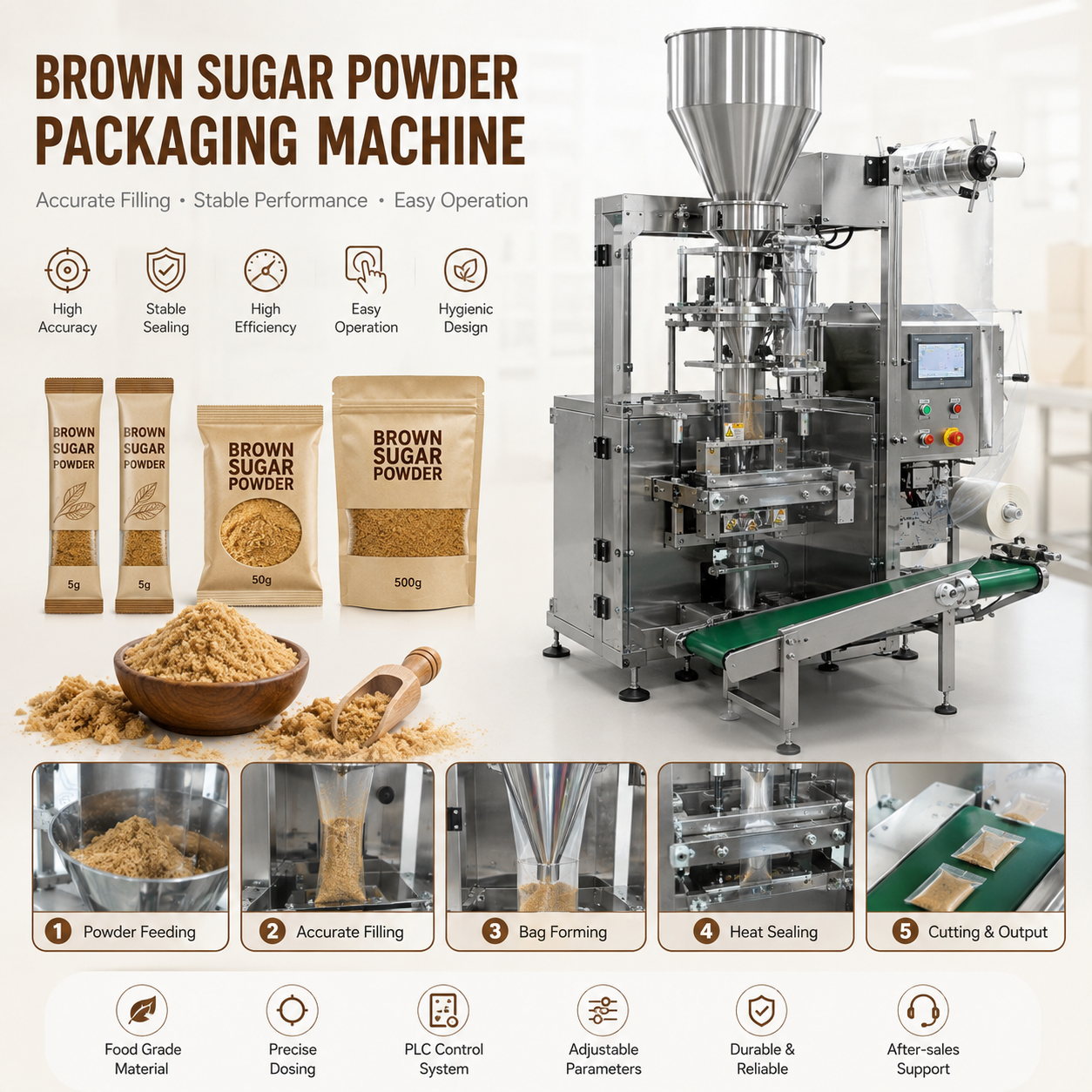
A typical system may include a product hopper, auger filler, film-feeding unit, bag-forming mechanism, heat sealing system, cutting device, conveyor, and PLC control panel. Depending on the customer's requirements, additional functions such as dust collection, automatic weighing, date coding, nitrogen flushing, or multi-lane packaging can also be integrated.
How Does Brown Sugar Powder Packaging Equipment Work?
The packaging process starts when brown sugar powder is loaded into the machine hopper. A feeding mechanism transfers the product toward the dosing system, where the required quantity is measured according to programmed parameters.
At the same time, packaging film is pulled from a roll and formed into the desired bag shape. Once the specified amount of powder is ready, it is discharged into the package. The sealing system then closes the bag before the cutting mechanism separates individual packages.
Main Operating Steps
Product feeding: Brown sugar powder enters the hopper and filling system.
Dosing: The auger or weighing mechanism controls the required quantity.
Bag forming: Roll film is shaped according to the selected package dimensions.
Filling: The measured powder is transferred into the formed bag.
Sealing: Heat sealing creates a secure closure.
Cutting and discharge: Finished packages are separated and moved to the next process.
This integrated process reduces manual handling and provides a more standardized packaging operation.
Key Features for Powder Sugar Packaging
Precise Auger Filling
An auger filler provides controlled powder dosing by regulating screw rotation. This technology is suitable for different filling weights and can help reduce excessive product giveaway.
Adjustable Packaging Parameters
Modern equipment allows operators to set filling quantity, bag length, sealing temperature, and machine speed through a touchscreen interface. This flexibility is useful for manufacturers producing several package sizes.
Stable Film Feeding
Accurate film tracking is important for maintaining uniform bag dimensions and sealing positions. Servo-controlled film feeding systems can improve synchronization during continuous production.
Reliable Heat Sealing
Brown sugar powder may produce fine particles around the sealing area, which can affect package integrity. Proper sealing temperature, pressure, and timing help create strong and consistent seals.
Automated Monitoring
Sensors can monitor film position, product level, sealing temperature, and other operating conditions. Alarm functions can notify operators when an abnormal condition occurs, helping reduce defective packages and unnecessary downtime.
Packaging Formats and Production Flexibility
Brown sugar powder can be packaged in different formats depending on the target market and distribution channel. Small sachets are suitable for hotels, restaurants, cafés, catering businesses, and individual consumers. Larger bags can be used for supermarkets, food-service applications, and commercial ingredient distribution.
A packaging machine can also be configured for different bag styles, including:
● Stick packs
● Four-side seal sachets
● Pillow bags
● Stand-up pouches
● Flat pouches
● Customized powder bags
The appropriate format depends on filling weight, product positioning, packaging material, shelf requirements, and production objectives.
Applications of Brown Sugar Powder Packaging Machines
Food Processing
Food manufacturers can use automated powder packaging systems for brown sugar, baking ingredients, seasoning blends, and other dry food materials.
Beverage Industry
Portion-sized brown sugar packages are suitable for coffee, tea, milk drinks, and other beverage applications where controlled serving quantities are required.
Bakery and Confectionery
Bakeries and confectionery manufacturers may use automated equipment to package brown sugar and other powdered ingredients for retail or commercial distribution.
Hospitality and Food Service
Hotels, restaurants, cafés, and catering businesses can benefit from individually packed sugar portions that are easy to distribute and store.
Ingredient and Private-Label Packaging
Contract packers and private-label manufacturers can use flexible powder packaging equipment to produce different package sizes and designs for multiple customers.
Benefits for B2B Manufacturers
Improved Production Efficiency
Automated filling and sealing reduce repetitive manual operations and allow manufacturers to maintain a more consistent production flow.
Better Filling Consistency
Controlled dosing helps maintain uniform package weights, which is important for product quality, cost management, and customer expectations.
Lower Labor Requirements
Automating several packaging stages can reduce the number of workers required for manual weighing, bagging, and sealing operations.
Reduced Product Waste
Accurate filling minimizes overfilling and helps manufacturers make better use of raw materials, particularly during high-volume production.
Flexible Production
Adjustable filling parameters and interchangeable components allow one machine to support multiple package sizes and product specifications.
How to Select the Right Brown Sugar Powder Packaging Machine
Before purchasing equipment, manufacturers should evaluate the complete production requirement rather than focusing only on machine speed.
Important factors include:
Product characteristics: Consider powder particle size, moisture level, flowability, density, and tendency to form lumps.
Filling range: Determine the minimum and maximum quantity required for each package.
Production capacity: Calculate the required bags per minute based on daily output and future production plans.
Packaging format: Decide whether the application requires sachets, stick packs, pillow bags, or larger pouches.
Film specifications: Confirm the packaging material, film width, thickness, and sealing requirements.
Factory layout: Check available installation space and compatibility with existing conveyors or production equipment.
Automation level: Determine whether additional equipment such as conveyors, coding machines, checkweighers, or metal detectors should be included.
After-sales service: Evaluate installation support, operator training, spare parts availability, warranty coverage, and technical assistance.
Maintenance Requirements
Regular maintenance helps maintain filling accuracy and extend equipment service life. Powder residue should be removed from the hopper, auger, filling tube, and other product-contact areas to prevent buildup and maintain hygienic production.
Operators should regularly inspect the auger screw, motors, sensors, sealing components, and film-feeding mechanisms. Filling accuracy should also be checked periodically to identify deviations before they affect large production batches.
For factories operating multiple shifts, establishing a preventive maintenance schedule can help reduce unexpected downtime and keep the packaging line operating consistently.
Future Development of Powder Packaging Equipment
The development of powder packaging machinery is increasingly focused on automation, intelligent monitoring, flexible production, and material efficiency. Advanced control systems can collect operating data and provide manufacturers with greater visibility into production performance.
At the same time, packaging manufacturers are exploring equipment compatible with recyclable and lightweight film structures. Improved servo control, automatic adjustment, and predictive maintenance technologies are also helping production lines become more efficient and easier to manage.
For B2B manufacturers, these developments create opportunities to build packaging lines that can adapt to changing product specifications and market requirements.
Conclusion
A brown sugar powder packaging machine provides an efficient solution for manufacturers that need accurate dosing, reliable sealing, and automated packaging of powdered sugar products. By combining suitable feeding technology with precise filling, flexible bag forming, and intelligent controls, businesses can improve production consistency while reducing labor and material waste.
The best packaging solution should be selected according to the product's physical properties, filling range, package format, production capacity, and future expansion plans. With the right equipment configuration, brown sugar manufacturers and food processors can establish a reliable packaging process that supports both current production needs and long-term business growth.